Saturday, January 14, 2006

Two Squares in a Roundhouse - Fujian

Our final bit of rural adventure for China was attempting to seek out the Hakka Roundhouses, which are located in southern Fujian province around the towns of Longyan and Yongding. Adventure, because despite featuring in photos in Lonely Planet there is a total of about 10 lines of text dedicated to both the houses and the surrounding town. So basically we didn't have much to go on (no maps, no recommendations), but considering other people obviously get there easily enough we figured it couldn't be that hard.

So anyways we arrived in Longyan at 4:15am (which made Hobbes a very grumpy boy) and (as we had promised Aimes' Chinese relos) stayed within the station until the sun came up. Unfortunately they don't seem to heat rural stations and we almost froze solid in the process.
.

Roundhouses

What we hadn't counted on was how soft we had become in the comfortable, polite, modern environs of Hong Kong and Macau and with the hospitality of Aimes' family in Guangdong. It came as a little bit of a shock to have to try and explain ourselves in very poor Mandarin, order meals by pointing and to have people staring at us again. This was particularly evident when it came to buying our onward train tickets, as it became apparent that our preferred route wasn't available and had to sort out an alternative in our broken Chinese.

We decided that the bus station was the most likely place to find a hotel, so we managed to find the right bus and sure enough after some pointing at the phrase book we had a room - the most expensive one we have stayed in throughout China surprisingly.

From the outside looking in

The next challenge was changing money, the bank we found obviously doesn't handle too many foreign currency transactions as when we presented our Hong Kong dollars many nervous looks and giggles were returned by the staff. However, after more giggling, several phonecalls, photocopies of our passports, more phonecalls and looking up several books we finally received our RMB. The Hong Kong notes were even passed amongst all the staff who didn't seem to have seen them before. We felt like telling them that it was currency from land which is supposedly part of China, but of course our Chinese doesn't stretch quite that far. At least we had an official security escort throughout the process as the bank's guard was very interested in the proceedings and had his head stuck between ours the whole time watching what was happening (he seemed like a really nice guy, based on our smiles and gestures anyways).

Inside a Roundhouse

So it was now just down to locating the houses. After not seeing much action on the driver front in Longyan, we decided to head down to Yongding where our friend Patrick (the pom) had drivers find him wanting to take him out to see the houses. The bus trip down was yet another extended trip with 1 hour being stretched out to 2, as yet another road was reduced to one lane for both directions with trucks and buses chronically jammed for several kilometres.

Arriving in Yongding we were greeted by several people eager to drive us out to the houses ('tulou, tulou') and they even had maps with some English so we could work out which ones we wanted to see. After some negotiation and promises that it would take half an hour to get there we were off. One and a half hours later we made it to the houses...

Roundhouse living

Arriving made the hassles getting to the roundhouses worthwhile, the incredibly perfect circular shape and scale really becomes evident when you enter the houses and feel the walls wrapping around you. While not the biggest of the roundhouses, those which we saw were still massive standing 4 stories and housing 600 people (the biggest ones house over 1000 people). The oldest of the group was 600 years old and still going strong!
The search is over...

The houses were built as protection against bandits and wild animals and are as a result quite plain from the outside, but inside there is a plethora of activity with people going about their daily activities and livestock being raised within each of the mini-communities. Two of the houses we saw were still lived in and it was amazing to see people living as they had done for hundreds of years, with ducks, chickens and H1N5 germs flitting about everywhere.

A cold morning train trip

After spending too short a time looking around the houses (as always seems to be the case), we managed to retrace our steps back to Longyan before too long and before it became too cold! Longyan somehow seemed to be transformed by night as a very plain, standard Chinese rural town came alive with street markets and people everywhere. We even found the most luxurious internet cafe ever, very large with every computer having a big soft lounge (pity the connection wasn't the best).

Unfortunately an all too common sight!

Next morning it was back on a train, nice and early at 6am, headed for Xiamen where we change trains and head straight to Shanghai. So you could consider Xiamen our second and final stop in Fujian province, if only for a grand total of 3 hours. The most notable thing about Xiamen was very clear blue skies, something which is a bit of a novelty after so long in China!

Next stop Shanghai, our last destination in China - where have 3 months gone?

Back to the Roots - Guangdong

Guangdong provided a very comfortable reintroduction to mainland China, as due to the hospitality of Aimes' relatives we didn't spend one night in a hotel (despite some initial mix ups) and spent very little time having to find our own way around. The level of hospitality was such that we had to create diversions and decoys to allow us to actually pay for things, although it was still difficult to actually pay our share.
.

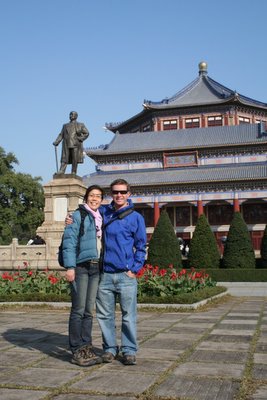
The Sun Yat Sen Memorial (and Aimes looking like a dork)

Guangzhou was our first stop where we were accommodated, guided and chauffered by Aimes' Aunt, Uncle and Cousin. The accomodation was first rate, particularly the fact that you only had to take the lift down to level 2 from Aimes' uncle's apartment for morning Yum Cha!

Yum Cha Brekkie - take your pick!

It seems the place has definitely changed for the better, as Aimes remembers only being able to stay for a short time on her previous visit on account of the pollution, yet we now found it to be one of the cleanest and modern cities in China. This was particularly evident on our drive along the Pearl River waterfront where there are wide tree lined footpaths, iconic buildings (the piano shaped concert hall to compete with the Sydney Opera House) and beautiful lights. We also had the numerous bridges, flyovers and tunnels designed or being designed by Aimes' Aunt pointed out to us, much to Hobbes' interest (being a fellow engineer when he decides to work).

The only animals which weren't on the menu...

Aimes' relos had devised a packed itinery for us and we managed to see in one day what would have taken us 2 or 3 to see on our own. We stopped at the Sun Yat Sen Memorial Hall (actually much of Guangzhou seems to be a tribute to Sun Yat Sen), past Aimes' mum's old boarding school, to the Chen Clan Ancestral Hall, a Tomb and Guangzhou Park (so Hobbes could take a photo of the goat statue - the city's mascot).

Looking inside Aimes' Mum's old house

We had a big lunch at a place that was hard to describe, it was a safari park/country club/resort all in one, complete with live white tigers in an enclosure in the middle of the building! The banquet was a full on affair with the safari theme continued onto the menu, with a whole menagerie of different animals appearing. The dishes consumed included, but were far from limited to, snake, crocodile, veal, lamb, fish, eel and prawns. A birthday cake had even been arranged for Aimes to recognise her successful completion of 27 wonderful years!

Sleepy boys in a train station waiting hall

This gastronomic assault on the animal kingdom was continued at dinner where yet more meats were presented, including quails, chickens, (baby) geese, ducks, (baby) pigs, more fish, more prawns, more eel. Hobbes' meat count by the end of the day was somewhere around the twelve mark for different animals consumed - not a day for the vegetarians. This more than reaffirmed the culinary reputation of the Cantonese.

The highlight of the day was visiting the old house that Aimes' mother had grown up in. As we walked down the street all the neighbours spilled out into the lane to have a gawk at what was going on, when they realised it was Ping's daughter everyone was inviting us in for tea and wanting us to take photos. The house itself is now been left derelict and has been boarded up, one neighbour though, brought out his bamboo ladder to help us get up and take some photos through a window.

Aimes, relos ... and cannon

After Guangzhou we ventured down the road to Donguan to visit the other side of the family. After being escorted to the Guangzhou station by Aimes' uncle and with words of warning about pickpockets still ringing in our ears we arrived at Donguan and were met by more of Aimes' relatives who quickly separated our luggage from us (despite our protests) and headed off to load it into the car.

The old and the new

With a car-full of distant relos (4 of us on the back seat) we drove around the countryside seeing some of the local sights. After a day trip around to a gun deck where part of the Opium War was fought, and a visit to the Sea Battle Museum (with an interesting/disturbing 'Drug Education' exhibit) we spent the afternoon at Bao Mo Park which seems to have been heavily influenced by Beijing's Summer Palace. The park is more waterway than land and the waterways even continue under the footpaths allowing the thousands of carp to follow your every move. Feeding these over zealous fish was an amazing experience as the pools are turned into whitewater at the mearest hint of food with streams of fish coming from every direction.

Fish feeding frenzy

That evening our over eating (and meat consumption) continued with yet another feast with the extended family.

The next day we headed out to (what was once) the country and visited the village that Aimes' great, great grandfather hailed from before coming to Australia. However, what was once a small village (as recently as Aimes' visit 8 years ago) has now morphed into yet another part of the sprawling metropolis that is Guangdong, complete with buildings rising before your eyes and multi-lane expressways.

Chan

We walked through the lychee orchard that Aimes' great great grandfather had farmed and then visited his grave. Chinese industry is rapidly replacing farmland in most parts and that trend wasn't any different here. On a hill, all you could see on the horizon were factories encroaching on the town. The Chinese government is now reclaiming the land of the whole cemetery and all the folks are being 'evicted' and moved to a newly built family tomb in the new year. Feng shui masters had selected a new spot and a ceremony with monks and nuns will be conducted upon the move.

Boy in Sook Bin

The Chinese tradition of ancestral worship was practiced and we spoke to to Aimes' great great grandparents and asked them to bless us. One Aunty insisted that Hobbes speak to them, as they had lived in Australia and understood English. Hobbes was a little weirded-out by talking to dead people, but he did a great job all the same.

Mapping out the ol' 'Leanfore' House

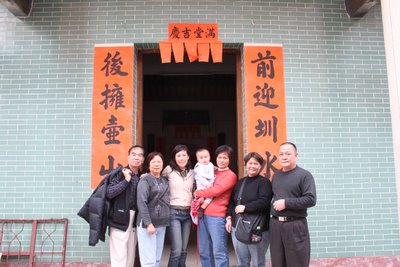
Back in town we visited some very distant relos that hail from the same great great great grandfather (which was pretty amazing that we could even go back that far) and then went to the town temple and family gathering house (with Aimes' father's name engraved on a plaque). Originally all the inhabitants of the village were decended from the same ancestors (including Aimes' families) and despite the changes underway, it seems a lot of them still remain. Aimes' Aunt seemed to know quite a lot of them and would introduce us to what seemed random old people we passed on the street who seemed to understand who we were?

Family (five times removed)

The most exciting part was visiting the Leanfore house. Now, left uninhabited the house contains many dusty relics and antique furniture which is locked up and only opened when visitors come. The house appears to be pretty much unchanged from the time when Aimes' grandfather would have lived there.

Aimes' (nutty) Aunt...

It was good fun spending a couple of days touring around with Aimes' family, seeing so many meaningful things and having a lot of laughs along the way. In addition to the family sights Hobbes was taught how to kill someone with three and two finger kung fu moves by an old uncle and we witnessed Aimes' aunt take a butcher's apron in a market to pose for a photo brandishing a large knife...

Wednesday, December 28, 2005

Portuguese style China - Macau

Tiny little Macau, so much colour - what a refreshing change from the rest of China! Of course most Chinese only come here for the gambling, but they are missing out on so much because it is such a nice place to spend a couple of days wandering around admiring the architecture and over indulging on the food.
.
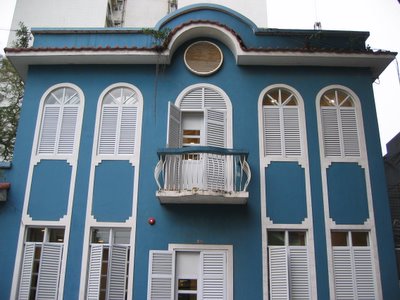
Portugese style building in Largo do Senado

We loved the gorgeous colourful facades of the Portugese influenced architecture, so much blue, yellow, pink, green, much more preferable to the usual 10 shades of grey on the mainland! Once again it was difficult to believe that we were still in China, the Catholic Churches on just about every corner are a far cry from the Tibetan monasteries and Muslim mosques that we had seen previously in our trip. Armed with a brand new camera from Hong Kong, there was plenty of scenery to keep us happy snappers busy. .

Macanese tarts and scooters, two icons of Macau

There seems to have been a real effort to maintain the Portugese feel, with old colonial buildings and forts restored and all signs written in both Portugese and Chinese. With the cobbled back streets filled with fashionistas on their European scooters, you could have easily believed that you had been transported half a word away, if it weren't for all the black hair perhaps.

The facade of the church of St Paul

Doing up your car is obviously the thing to do with plenty of nice ones cruising the narrow streets and laneways. It is also probably the first and only time we are likely to see Vespas and Lambrettas covered with Astro Boy, Seasame Street and Hello Kitty stickers! Though they are definitely serious about style here, no Honda Dreams or Waves, all the bikes are European or "European styled".

The antique furniture shops provided the temptation to spend some money for a little while, but having no abode and no fixed address (and with no prospect of having one for a while), the fantasies were swifty put to an end.

Macanese colour (and laundry)

More Macanese colour

Even further Macanese colour

The Macau Museum was one of the best we have seen (the quality of the English explanations made us suspect that most of the exhibitions may have been created before the handover), particularly the comparisons between Portugese and Chinese culture at the time of colonisation. After having spent some time walking around the place it was good to see the ways in which the two cultures had influenced each other.

Macau also offered a nice change to our palettes with yummy Macanese cuisine to try. We feasted on delicious seafood, chorizo and portuguese chicken and for the first time in ages, proper rosetta rolls and extra virgin olive oil to dip in. It was gastronomic heaven topped off with special Macanese tarts that were derived from the unique combination of Chinese 'darn' tarts and Portuguese tarts. Aimes had trouble resisting them (and the almond/mung bean cookies) after each meal and borded the bus out of Macau to Guangzhou a couple kilos heavier, armed with her brand new saddle bags.

Coloane Wharf

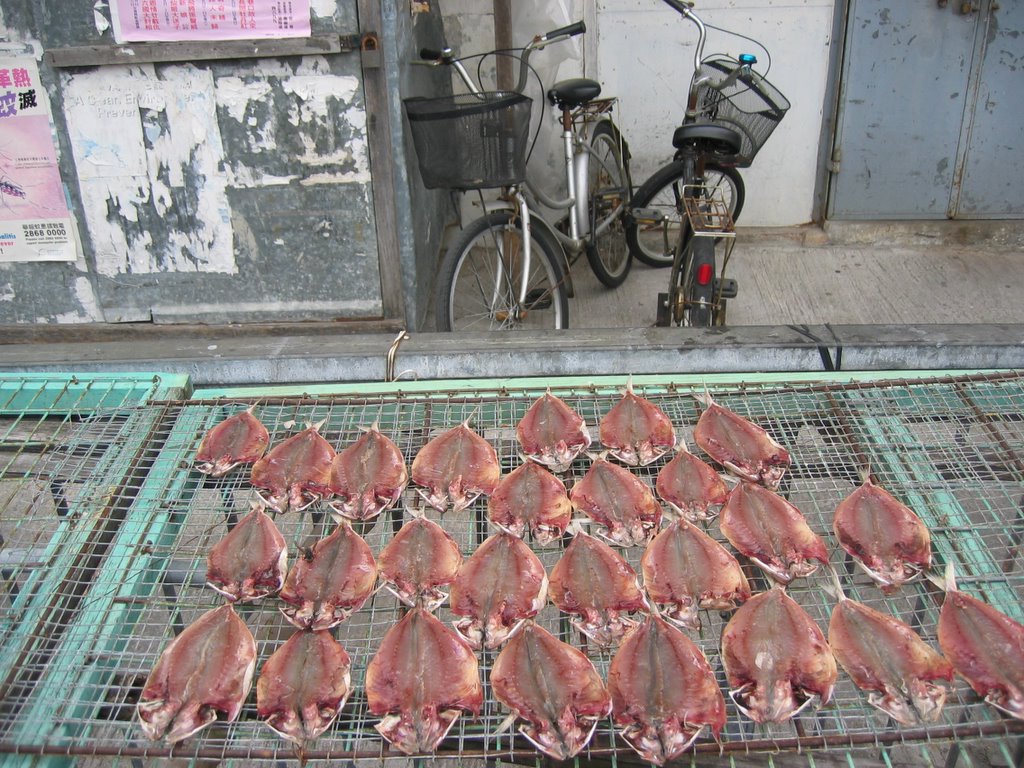
Drying fish in a village on Coloane

There is definitely a sea-faring feel in Macau, with it's many forts, harbours and Ama Temples (for the Chinese fishermen). Particularly on the 'islands' of Taipa and Cologne (they have long been linked to each other by a massive causeway), where we walked around and explored the quaint fishing villages. Even the beaches are European styled - complete with unattractive black sand! As at Tai O in Hong Kong these villages were so quiet and sleepy that it was hard to fathom that we were only a 30 minute bus ride away from the centre of town.

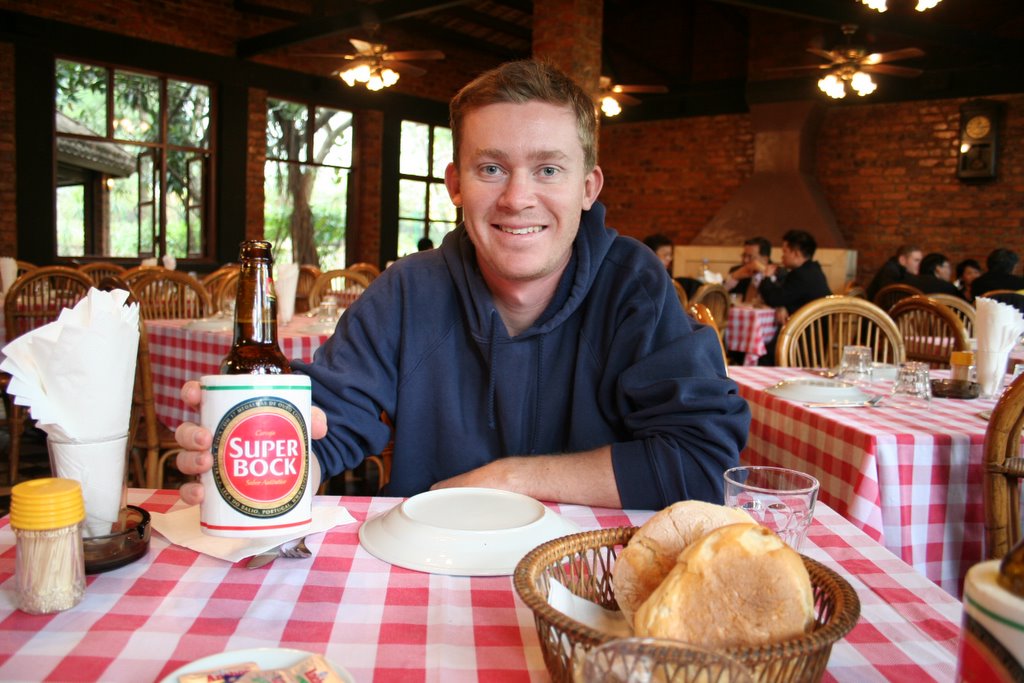
Super Bock!

The Roman Catholic influence - the Chuch of St Dominic

Perhaps the only downside we experienced during our time in Macau was being reaquainted with mainland tourists, which very quickly reminded us that the politeness and courtesy we had been revelling in while in Hong Kong was but a brief respite. No more people holding doors open for you or complete strangers in coffee shops offerring to call their son to find out directions for you, just pushing and shoving, walking in front of your photos and coughing (in your face)! Can't wait to get back to the proper China in a couple of days!

We're not on the mainland anymore, Toto (and Hobbes road testing the new camera)

Portugese/Chinese fusion

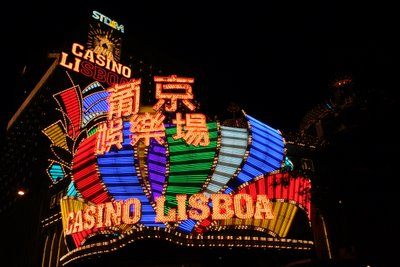
On our last night we thought we couldn't really come to Macau without checking out the casinos. We checked out the Lisboa, one of the originals and seemingly still one of the most popular. It was full of many mainlanders, almost exlusively men, all eager to part with some of their hard earned. The casino isn't flash, there's none of the flashing lights, fake palm trees and tacky art works that make other casinos so appealling, guess people were there for one reason only- to gamble! In fact the two floors looked exactly the same, except one was non-smoking and the other smoking (and smokey - so much so that it would have been difficult for the gamblers to see their cards!).

Macau isn't immune to the Chinese construction boom

Bakery-goodness (fresh almond cookies that contibuted to Aimes' saddle bags)
So that was it for the SAR's (Special Administrative Regions), from here it was back to the mainland for a few more weeks. The boarder crossing from Macau into Guangdong was almost as interesting as the lift at Hong Kong with hundreds of people crossing pulling little trolleys with one box on each. Not sure what it was all about, but must have had something to do with avoiding taxes or duties on imports?

Why most Chinese love Macau

I Heart Hong Kong

Ah ... Hong Kong! You've gotta love this place, a wonderous mix of East meets West. From soaring skyscrapers and bright neon lights to quaint fishing villages and national parks, there is so much here to entertain both of us.

After yet another long haul journey (on a train which decided to 'go slow' between Guangzhou and the border) we arrived at Shenzhen and crossed the border from China into not-quite China by 'escalator'. A little travel weary, we arrived in bustling Tsim Sha Shui to be greeted by swarming touts offering their discount rooms in the manky building known as the infamous 'Chungking Mansions'. Mansions by name but defintely not mansions by nature! This old dilapidated building is a host to many budget hostels and which, although a little basic, was what we were to call home for the next 10 days.


There's a first for everything!

Aimes and Mimi in Lan Kwai Fong

We immediately freshened up and hit the streets to meet up with Mim who was there enroute to Delhi for a friend's wedding. Sporting a new Honky perm we almost didn't recognise her from behind. Though it was really great to see a familiar face. We set out for some food as Hobbes was a little cranky as he hadn't eaten all day (it was 3 o'clock!), our first taste of Hong Kong was the speciality - a steaming bowl of true wan ton noodles! Yum!

We spent the arvo and evening walking around town, catching the famous 'Star Ferry' across Victoria Harbour and grabbing a drink in the VERY exi Lan Kwai Fong area. The next day we sampled the local fare by visiting Mim's aunt's favourite 'hole in the wall' congee shop, where what was meant to be pork congee for Hobbes ended up coming out from the kitchen as pig's liver! Aimes and Mim had lots of Cantonese practising to do!

The 'glamorous' Chungking Mansions

As it was Sunday, it was 'maids day off' in Hong Kong. Every street and bit of parkland was full of 'picnicing' Filopino women who use this day to shoot the breeze with their fellow maids. Walkways, footbridges and mall areas were all full of women gathering, chatting away, playing cards and picnicing on flattened cardboard boxes. The whole city seemed to be brimming with young and old Filopino women - it really made you wonder exactly how many people have maids in this city.

The commercial heaven of Causeway Bay

Definitely the best way to get around

Sunday also coincided with a pro-democracy march, which having been in China for so long seemed a little inappropriate (it was then that we realised we'd been corrupted by watching too much CCTV). We were at Central later that evening when the news on a giant LCD screen showed a piece on the march - all the people on the street broke out into a spontaneous applause, it was a very uplifting moment seeing so much community spirit in a big city. However, the channel was quickly changed at this point, suggesting that the Chinese Big Brother wasn't too far away...

Starting the following week was the well publicised and contentious WTO conference, it took a lot of convincing to explain to Aimes' relos that we weren't visiting HK to partake in some rioting shenanigans with the Korean farmers and cop pepper spray in the face (although it was a worthy cause).


Avenue of Stars - last night Jackie Chan came round...

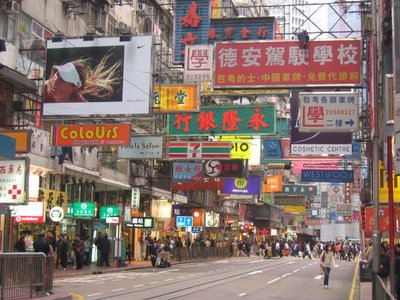
More commercial craziness - Mong Kok

Though the HK police did pay us a visit on one night of our stay in Hong Kong. Our hostel was raided at three in the morning for a passport check... one of the unmentioned benefits of staying at Chungking Mansions!

Being December, Hong Kong had certainly got into the 'consumer', if not quite 'Christmas', spirit. Every mall and shopping centre had extremly elaborate decorations, each seemingly trying to out do the other. The most spectacular was the 8pm light show each night, where most buildings along the harbourside skyline were lit up with Christmas lights and a laser show. It was like a whole city had been turned into a giant (if very quiet) rave party. We enjoyed walking along the 'Avenue of Stars' (a la Hollywood, but with Chinese actors), watching the kids go nuts over the light display.

Aimes gets a bit carried away with online gaming...

People, people and more people

Of course the consumer spirit is at the heart of Hong Kong and despite our meagre funds, we tried our best to join in (when in Rome...). Several kilometres were walked around the streets and shops of Causeway Bay, Mong Kok, Temple Street and Tsim Sha Tsui, resulting in a couple of boxes having to be sent home...

During our time in Hong Kong it felt as though we used just about every type of public transport available - ferries, subway, buses, trams, trains. Fortunately Hong Kong is a little (maybe that should be light years) more advanced than Australia with the 'Octopus' smart card being able to take us all over the island, surrounding islands and even to Macau. It really set a precedent for how good a transport system can be if there is some investment into it!

Hong Kong's skyline by night

Also, on the planning front, we visited the Urban Planning exhibition which showed us how much of the harbour is being reclaimed to build a public waterfront precinct. The jokes around town is that one day the island will meet the Kowloon side with all the rubble they are pouring into the harbour.

The Bank of China Building

Our trip to Lantau island was a little poorly planned as the day we went was full of blustering freezing winds. We explored the quaint and colourful fishing village of Tai O and walked out to the windy headland looking out to the new airport. It is hard to believe that such a sleepy place can be only half an hour away from the big city lights of Hong Kong Island - it was like the central coast on valium! The big Buddha, temple and Lantau Peak were given a miss as the weather was not going to change in our favour any time soon.

The colour of Tai O

Brrrrr...cold weather on Lantau Island

Drying fish, Tai O Village

Being able to eat Cantonese food for the first time in 3 months (it is surprising how much you miss soy sauce) was one of the unexpected benefits of being in Hong Kong, Yum Cha of course being the highlight. We visited one restaurant in the city hall with views over the harbour and caught up with 'Pat-rick' (the Pom from our trip in Mongolia). 'Char-siew farn' (BBQ Pork with rice) was also another favourite - much better than the Sydney stuff, returning twice to one little shop in Soho for it, where Anthony Bourdain had given his tick of approval. We were taken to the acclaimed 'Tai Foo' by one basketball-touring 69 year old uncle who is spritely as a 20 year old, and also had yet more yum cha with an another uncle and aunt who were going to take us to Aimes' great great grandfathers' village on the mainland in the coming week.

Waiting for a bus on Lantau Island

Temple Street Night Market

Soho was also cool for antique shops (although overly priced compared to the mainland) and a little temple called Ma Mo which has the beautiful incense coils hanging from the ceiling. We went to the Soho Festival one Sunday, which was a little tame, with a bit of face painting and some beer stalls on the street (maybe it should have more accurately been referred to as a Heineken Promotional event) - give us the Surry Hills Fest or Newtown Fest anyday! The only highlight was taking the world's longest escalator up to the mid-levels. Also from the mid-levels we walked around to join the throngs of weekend tourists to take the famous Peak tram to the top for that great view over the island and surrounding area.

Soho streetscape

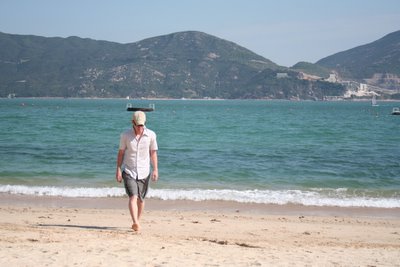
Hobbes on Stanley's Main Beach

Lifeguard tower at Repulse Bay

To top off our stay in Hong Kong we dropped the pace a bit and spent a relaxing day down on the south side of Hong Kong island visiting Stanley and Repulse Bay. In contrast to our trip to Lantau Island, it was a perfect sunny day and the best part was rolling our jeans and sleeping on the beach soaking up the rays - although Hobbes was tempted to strip right down and plunge into what would have been freezing water (such a Piscean!).

Connaught Road, Central

South Korean farmers protesting against the WTO

Soon after this we had our passports returned with our shiny new Chinese and Indian visas which meant we could start to think about moving on (and back to the mainland...). So despite the temptation of joining in the anti-WTO protesting fun, we decided it was time to depart and booked ourselves on a boat to Macau.